Design – Manufacture – Installation – Service – Spares
Need to vent: why dust filtration design can be a matter of safety
Dust is an unavoidable by-product of countless industrial processes. In sectors from food production and pharmaceuticals to woodworking, chemical processing, and metalworking, fine particulate matter is generated constantly. Managing it effectively is both a regulatory requirement and an operational necessity. But there is a dimension to dust management that goes beyond filtration efficiency and compliance. Get the design wrong, and dust doesn’t just become a nuisance. It becomes a hazard.
The hidden danger in dust
Many industrial dusts are combustible. When fine particles are suspended in air at the right concentration, all that is needed to trigger an explosion is an ignition source. In a poorly designed or inadequately maintained dust extraction system, that ignition source can come from something as apparently routine as a spark from machinery, a build-up of static electricity, or even the friction generated by a blockage within the system itself.
The consequences can be severe. A primary explosion within a filter unit can send a pressure wave through connected ductwork, disturbing settled dust elsewhere in the facility and triggering a series of secondary explosions that are often far more destructive than the first. Combustible dust explosions have caused fatalities and serious injuries in industrial settings across the world, and in many cases the root cause has been traced back to filtration systems that were either not designed with explosion risk in mind, or had not been properly maintained.
Design is everything
The good news is that the risks are well understood, and when a dust extraction system is designed correctly from the outset, they can be effectively managed. This begins with a proper assessment of the dust being handled. Particle size, concentration, and the material’s specific combustibility characteristics all inform the design of a safe system.
For installations where combustible dust is present, explosion protection measures need to be built in, not added as an afterthought. These typically include explosion venting panels, which are engineered to relieve pressure safely in the event of an ignition, directing the force of any explosion away from operatives and critical equipment. Where ducting is present, isolation valves and suppression systems are required to prevent propagation back into the work area.
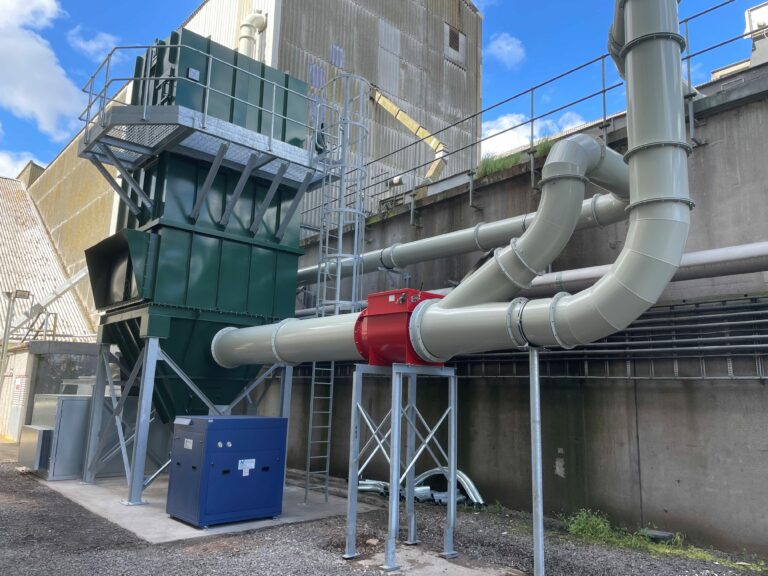
The filter units themselves need to be specified with the right casing materials and construction to withstand the conditions they operate in. Earthing and bonding to manage static discharge, spark detection and suppression systems within the ductwork, and the use of antistatic filter media are all elements that a competent filtration engineer will consider as part of a complete solution. Design parameters of the filter units should be carefully considered when dealing with combustible dust, and it’s not as easy as just incorporating an explosion vent panel on the filter.
Don’t leave it to chance
If your dust extraction system was not specifically designed with explosion risk in mind – or if it has been modified, extended, or is handling different materials than it was originally specified for – it is worth having it reviewed by specialists.
At Pennaire Filtration, our engineers have the experience and technical knowledge to assess existing installations and design new systems that meet current safety standards, including compliance with ATEX regulations and the relevant DSEAR requirements. Because when it comes to combustible dust, the cost of getting it wrong is one no business should be willing to pay.